CONNORRIDGE FARMS

The Oxford Prairie Dairy
You're heard you should eat local, grass-fed, farmer-owned, humanely raised, grass-finished, organic, or regenerative. We truly support every business out there that is taking the time to try to pursue these positive impacts. For our team, one goal is restoration (or more precisely, reconstruction) of Iowa's tall-grass native prairie. Tall-grass prairie across Iowa was once grazed by huge herds of bison. The deep roots filtered our water, prevented erosion, and provided spectacular habitat. Impressively, the biodiversity in native remnant tall-grass prairie may be second only to the tropical rainforest, but it will take time and work to reconstruct this habitat.
Grazing dairy cows on restored tall-grass prairie would be difficult for large producers at the current prices of milk, but our goal is to determine if it is feasible for local, specialty dairy and creameries. To spread knowledge and demand for these practices, please help grow our social media presence and tell your friends.
Why settle for grass-fed when you could have prairie-fed!
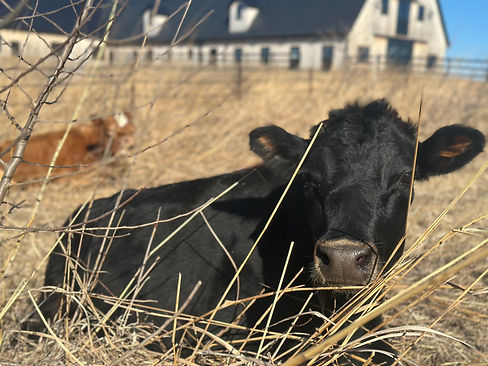
It starts with our grass
We currently have just one mini-jersey cow in milk- S'mores. She rotates between three pastures. The first, "behind the barn", is currently mixed grass, including non-natives like brome, as well as a mix of Maximillian sunflowers and some natives that have spread from our other pasture. In spring 2025, after the barn was completed, we planted the steep hills with a native grass/forbes mix made specifically to avoid toxic plants. Over the next year we plan on continuing to work on the brome, with the cows helping us graze it down.
Our other two pastures are north of the barn. One is fenced off prairie that was recontructed by the former owners prior to 2012. It has done remarkably well with grazing, but in 2025 we fenced the middle of the pasture (about 2 acres) so that grazing could be more deliberate. We plan on grazing it briefly, 2-3 times per year. Near this, there are smaller tracks where the cows are fed alfalfa from our fields when the prairie is not ready to be grazed. Over time, we plan to shift more alfalfa fields into Prairie.
Milking
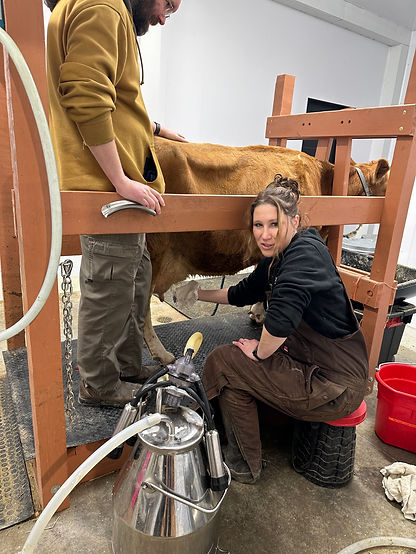
Milking at Connorridge farms is a family affair. The majority of milking is done by Grandpa Jack, but on weekends Georgina and Michael take their turns, and the littlest farmers help with chores including mucking stalls. The family has been milking this way, either one or two cows, since 2015 for home use only. Up until 2025 all milking was done in our 2-car garage. In 2025, we moved the operation to the new barn, and pursued becoming an inspected, approved dairy. The dairy and creamery were finally approved and licensed in 1/2026.

Our Formagier
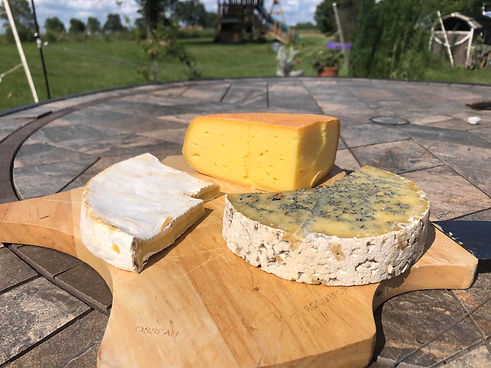
Grandpa Jack has been making cheese since the 1990s, sourcing milk from nearby farmers when we lived on the west coast. He even briefly taught cheese making classes at Kirkwood. In 2015, we got our first cow and Grandpa Jack began to perfect aged cheese from our own cows. Making an artisan cheese takes many hours. There's cooking, pressing, turning, pressing, and so on. After days of careful work, the cheeses are moved to the cheese cave for aging- a minimum of 60 days for most of our aged cheeses.
Cheese!
Formagier Jack makes a wide array of aged cheeses, while Georgina & Mike occasionally offer fresh pasteurized cheeses including Fromagina, mozzarella, and queso.
Descriptions of cheeses and other creamery products (including ice-cream) can be found here. Updated current availability can be found here.